Smart Natural Gas Alarm Guide: Listed Devices, Placement, and Emergency Response
A safety-first guide to evaluating a listed natural-gas alarm, auditing placement, preserving local warning, and responding without creating an ignition source.
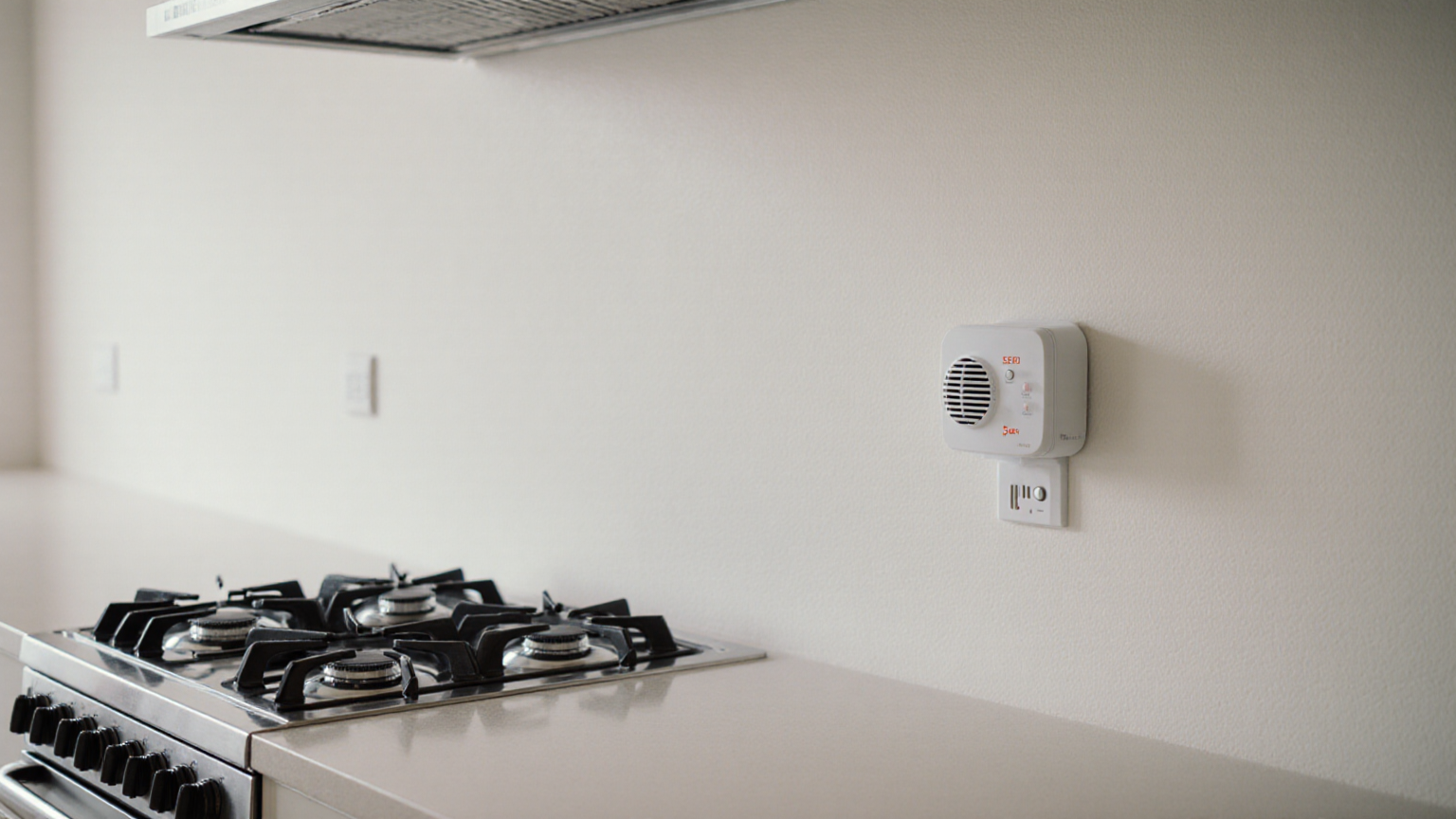
A natural-gas alarm can add an important layer of warning, especially when a leak is not noticed by smell. It is not, however, a substitute for properly maintained gas equipment, utility inspections, smoke alarms, carbon-monoxide alarms, or immediate evacuation when something seems wrong.
The safest buying and installation strategy is simple: choose a residential fuel-gas alarm with a verifiable safety listing, preserve its local audible warning, and install it exactly as its instructions and local authorities require. Treat phone notifications as a convenience—not as the alarm system itself.
If an alarm sounds or you smell, hear, or see signs of a gas leak: get everyone outside immediately. Do not operate switches, appliances, garage-door controls, flashlights, matches, vehicles, or phones while inside or near the suspected leak. From a safe location, call 911 and your gas utility. Stay out until emergency responders or the utility say it is safe to return. PG&E gives the same essential sequence: leave, avoid potential ignition sources, and call for help from a safe distance.PG&E gas-safety guidance
Natural-gas, carbon-monoxide, and smoke alarms do different jobs
These devices are not interchangeable:
- A natural-gas or fuel-gas alarm detects a combustible fuel gas that may be escaping before it burns. A residential device may be labeled for natural gas, methane, propane, or more than one fuel. Confirm that the listing and manual explicitly cover the fuel supplied to your home.
- A carbon-monoxide alarm detects carbon monoxide, a colorless and odorless toxic gas produced by incomplete combustion. It does not ordinarily detect an unburned natural-gas leak. The Consumer Product Safety Commission recommends CO alarms on every level and outside sleeping areas, while emphasizing that alarms are a backup to correct installation and maintenance of fuel-burning equipment.CPSC Carbon Monoxide Information Center
- A smoke alarm responds to products of a fire. It is not designed to provide early warning of an unignited gas leak or CO buildup. Ready.gov advises installing smoke alarms on every home level and replacing them according to the manufacturer’s instructions.Ready.gov home-fire guidance
A combination device may perform two or more of these jobs, but only if its markings and certifications cover each claimed function. A product description containing words such as “air quality,” “gas sensor,” or “smart detector” is not proof that the device is a listed residential natural-gas alarm.
A decision table for evaluating an alarm
This is a screening tool, not a product ranking. Local code, your gas utility, the authority having jurisdiction, and the device instructions can override any general consideration below.
| Decision point | Strong evidence | Warning sign | Action |
|---|---|---|---|
| Detected fuel | Manual and label explicitly name natural gas or methane used at the property | Generic “gas” or “air-quality” wording | Do not assume compatibility |
| Safety evaluation | Listing mark, standard, model number, and certification record can be verified | Marketplace badge or seller claim only | Verify before purchase or installation |
| Core warning | Loud local alarm operates without cloud access | Warning depends primarily on an app, hub, or subscription | Reject as the primary safety layer |
| Installation | Manual gives room restrictions, clearances, orientation, power, and mounting directions | Seller supplies a universal mounting height | Follow the listed instructions instead |
| Power supervision | Device reports low battery, loss of power, fault, or end of life as applicable | Silent failure mode is unclear | Resolve before relying on it |
| Household accessibility | Alarm can be heard or otherwise perceived by every occupant | App notification reaches only one person | Add listed accessibility measures |
| Lifecycle | Manufacture date, replacement date, support policy, and consumables are documented | No end-of-life plan | Choose a maintainable system |
| Smart security | Supported updates, unique credentials, and account protections are available | Shared default password or abandoned app | Isolate or avoid the connected feature |
What “listed” should mean in this context
UL 1484 covers electrically operated fuel-gas alarms intended for residential occupancies and recreational vehicles, including alarms intended to detect natural gas or propane; it does not cover smoke or fire detectors.UL 1484 Fuel Gas Alarms
Look for more than a familiar logo. Record the manufacturer, exact model, named standard, listing or certification mark, and any control-unit or accessory requirements. Check the certifier’s directory when possible. Similar-looking models can have different approvals, and a listing for electrical safety alone does not necessarily establish performance as a residential fuel-gas alarm.
Also distinguish listed use from available features. A device might have Wi-Fi, a digital concentration display, voice prompts, or automation integrations. None of those features proves that the gas-detection function has been evaluated for residential life-safety use.

Placement: audit the home before choosing a location
There is no responsible universal mounting height for every natural-gas alarm. Sensor design, airflow, room geometry, ignition sources, environmental limits, power configuration, and the exact listed use all matter. Instructions can differ among models, so a rule copied from another alarm may be wrong for yours.
Use this placement audit:
- Confirm the fuel and appliances. Identify the utility-supplied fuel and every connected appliance, including furnaces, boilers, water heaters, ranges, fireplaces, dryers, and outdoor equipment.
- Obtain the exact manual. Match its model number to the unit in hand. Do not rely on a reseller’s diagram or instructions for a related model.
- Map occupied and sleeping areas. Determine where the local alarm must be heard, including behind closed doors and by occupants with hearing or mobility limitations.
- Mark prohibited environments. Check the manual for restrictions involving humidity, grease, steam, dust, temperature, direct airflow, dead-air spaces, outdoor exposure, and proximity to appliances or ignition sources.
- Check power and orientation. Verify whether the alarm must be hardwired, plugged into an unswitched receptacle, battery powered, or mounted in a particular orientation. Do not use an extension cord unless the instructions explicitly permit it.
- Review local requirements. Ask the gas utility, fire department, building official, landlord, or licensed professional whether local code establishes additional locations or installation rules.
- Document each installed unit. Photograph its label and record the room, model, serial number, installation date, replacement date, power source, and manual location.
- Test audibility and accessibility safely. Use only the manufacturer’s test procedure. Never release fuel, use an open flame, or improvise with an unapproved test gas.
The home’s alarm map should separately show smoke, CO, and fuel-gas coverage. NFPA’s home-safety resources treat smoke alarms as a dedicated fire-warning layer, reinforcing why one sensor category should not be assumed to cover another.NFPA Home Fire Safety
For another example of why sensor location and operating conditions matter, compare this process with our smart radon monitor placement and calibration guide.

Smart features are secondary
Useful connected functions can include remote fault notices, low-battery alerts, event history, or notification to someone away from home. They also introduce dependencies: Wi-Fi, a hub, internet service, cloud infrastructure, an app, account access, and vendor support.
The device’s local audible alarm must remain the primary warning. A phone may be muted, offline, charging elsewhere, or outside the notification path. Do not configure an automation that silences, resets, delays, or conditionally suppresses a safety alarm. Avoid routines that automatically operate fans, lights, switches, doors, or fuel equipment in response to a suspected leak unless a qualified system designer and applicable code specifically authorize that arrangement.
NIST’s IoT cybersecurity program emphasizes risk-based cybersecurity capabilities across connected-device ecosystems.NIST Cybersecurity for the Internet of Things Program CISA’s consumer guidance recommends strong passwords, multifactor authentication, prompt software updates, and phishing awareness.CISA Secure Our World Apply those practices to the alarm account and hub, and review our broader smart-home lifecycle and security checklist.
What to do when the alarm sounds
Treat an alarm, a rotten-egg or sulfur-like odor, hissing or roaring, blowing dirt, bubbling water, or unexplained dying vegetation as a possible gas emergency. Utilities add odorant to natural gas, but odor may not always be perceived; do not dismiss an alarm merely because nobody smells gas. Federal pipeline-safety information likewise tells the public to recognize unusual smells, sounds, and sights and to move away before reporting a suspected emergency.PHMSA Pipeline Safety
- Tell everyone to leave immediately. Assist children, visitors, older adults, and anyone with mobility needs.
- Avoid possible ignition sources. Do not touch light switches, thermostats, plugs, appliance controls, garage-door openers, or doorbells. Do not light a match or smoke.
- Do not use a phone inside. Take it with you only if doing so does not delay evacuation; make calls after reaching a safe location.
- Do not investigate. Do not search for the source, unplug the alarm, open equipment, or reset the event to see whether it returns.
- Call from safety. Contact 911 and the gas utility using the utility’s published emergency number.
- Keep others away. Warn people without re-entering the affected area.
- Do not return. Wait for explicit clearance from emergency responders or the utility. Do not restart appliances or restore gas service yourself.
If there is fire or smoke, follow the fire escape plan and call 911. Ready.gov notes that home fires can become life-threatening rapidly, which is why evacuation—not diagnosis—is the priority.Ready.gov home-fire guidance
Renter and owner branches
If you rent
- Notify the landlord or property manager after reaching safety and calling emergency services or the utility.
- Request the alarm manual, model information, inspection history, and the property’s smoke/CO/fuel-gas alarm responsibilities in writing.
- Do not drill, hardwire, relocate equipment, or alter gas appliances without authorization.
- Report missing, expired, damaged, or repeatedly faulting alarms promptly and retain the correspondence.
- If management advice conflicts with emergency responders, the utility, the listed instructions, or applicable code, follow the safety authority—not a request to remain inside and troubleshoot.
If you own
- Inventory gas equipment and arrange qualified service when an appliance, vent, connector, or fuel line is suspect.
- Confirm permitting and code requirements before hardwiring, adding shutoff equipment, or integrating an alarm with a security panel.
- Maintain manuals, listing records, installer information, and replacement dates with the home file.
- Include alarms, hubs, routers, and backup power in a smart-home outage and power inventory.
- If gas service is shut off, let the utility or another authorized professional restore it and relight equipment as local rules require.
Monthly and seasonal checks
Create a monthly reminder, but perform only checks permitted by the manual:
- Inspect for blocked openings, paint, grease, dust, physical damage, unplugged cords, or removed batteries.
- Confirm that status indicators show normal operation.
- Use the test button or prescribed test method at the manufacturer’s stated interval.
- Verify that the local sounder—not merely the app—operates.
- Review fault, low-power, end-of-life, and connectivity indications.
- Confirm that every occupant recognizes the alarm and knows the outside meeting place.
- Check that the utility emergency number and home address are easy to access from outside.
At the start of heating season, review furnace or boiler service, vents, alarm dates, and household evacuation needs. After a power outage, router replacement, app migration, tenant turnover, renovation, or account-password change, recheck power, local warning, notifications, and documentation. Never use an improvised gas release to test a sensor.

Important limitations
A residential alarm cannot prevent a leak, repair piping, guarantee detection in every room, or prove that a building is safe after an event. Air movement, obstructions, contamination, sensor aging, power loss, incorrect placement, or using the wrong device for the fuel can reduce protection.
A phone notification is not proof that people inside heard the alarm. Conversely, a missing phone alert does not make a local alarm unimportant. Consumer alarms also do not replace occupational instruments, utility leak surveys, code-required systems, or professional diagnosis.
Most importantly, no reading or app status should overrule human warning signs. If you suspect gas, leave and call for help even when the display says “normal.”
Frequently asked questions
Can a carbon-monoxide alarm detect a natural-gas leak?
Not unless the exact device is also specifically listed and labeled for natural or fuel gas. CO and unburned natural gas are different hazards. Maintain the required CO alarms even after adding a fuel-gas alarm.CPSC Carbon Monoxide Information Center
Where should I mount a natural-gas alarm?
Use the location, orientation, clearances, and environmental limits in the exact device instructions, then reconcile them with utility, fire-code, and building requirements. There is no universal height that is correct for every listed device and room.
Should it be beside the furnace, stove, or water heater?
Only if the instructions permit that location and clearance. Being too close to appliances, airflow, heat, steam, grease, or contaminants may violate the device’s installation conditions.
Is a plug-in smart gas sensor enough?
Only when its gas-detection function has the appropriate residential listing, covers the correct fuel, and is installed as directed. Connectivity, reviews, or a mobile app are not substitutes for verified alarm performance.
What if the alarm sounds but I cannot smell gas?
Leave anyway. Odor perception varies, and PG&E explicitly warns against relying only on smell.PG&E gas-safety guidance Call 911 and the utility from a safe location.
Can I silence the alarm before leaving?
Do not delay evacuation to silence, reset, unplug, or investigate it. Get outside, call for help, and stay out until authorized to return.
Can I shut off the main gas valve myself?
Do not remain in or approach a suspected hazardous area to operate a valve. Follow your utility’s emergency instructions. Once service is off, restoration and appliance relighting may require the utility or another authorized professional.
Do smart alerts make remote troubleshooting safe?
No. A remote alert can help you notify occupants or emergency services, but it cannot establish conditions inside. Tell anyone present to evacuate rather than asking them to inspect the alarm or appliance.